Long before cities, cars, and crowded streets, enormous creatures walked across our planet. Some were gentle plant-eaters with long necks. Others were fierce hunters with sharp teeth. Some had horns, plates, spikes, or thick armor. Together, they created one of Earth’s most fascinating prehistoric stories.
That is why dinosaur riddles are such a fun way to play with words and learn about the ancient world.
A good dinosaur riddle makes you imagine giant footprints in the mud, hear a mighty roar, or picture a long tail swinging through a prehistoric forest. It also gives your brain a small mystery to solve. Kids can build vocabulary and learn dinosaur names, while adults can enjoy testing their memory and prehistoric knowledge.
This collection is made for children, parents, teachers, classrooms, families, dinosaur-themed parties, road trips, and anyone who thinks dinosaurs are totally dino-mite. Some clues are easy enough for young paleontologists, while others may make even serious dino fans stop and think.
Take a deep breath, sharpen your guessing skills, and prepare to travel millions of years into the past.
The prehistoric puzzle hunt begins now!
💡 Did You Know?
- Birds are living dinosaurs. Modern birds are part of the dinosaur family tree, so when you watch a bird hopping around your yard, you are seeing a living descendant of ancient dinosaurs.
- The word “dinosaur” has a scientific history. British scientist Richard Owen introduced the term in 1842, combining Greek words meaning “terrible” and “lizard.”
🎯 Riddle of the Day
I walked on giant feet beneath prehistoric skies,
With a long tail behind me and a towering shape that could rise.
Can you guess the answer? Comment below!
🦖 Easy Dinosaur Riddles for Kids
Dinosaur names can look tricky, but these riddles keep the clues simple and playful. They are perfect for young dinosaur fans, family games, classroom brain breaks, or a quick activity during dinosaur week.
- I was a three-horned plant eater with a big shield around my head. 👉 Triceratops
- I had three toes, tiny arms, and a mouth full of sharp teeth. 👉 Tyrannosaurus rex
- I carried huge plates along my back like a walking row of shields. 👉 Stegosaurus
- I had a long neck that helped me reach leaves high in trees. 👉 Brachiosaurus
- I was a duck-billed dinosaur with a broad, flat mouth. 👉 Hadrosaur
- I had a club-like tail that could help defend me from danger. 👉 Ankylosaurus
- I was a small dinosaur with feathers and a name linked to birds. 👉 Archaeopteryx
- I had a long, narrow skull and powerful jaws for catching prey. 👉 Spinosaurus
- I was a fast hunter with a sickle-shaped claw on each foot. 👉 Velociraptor
- I wore bony plates and had a tail armed with sharp spikes. 👉 Stegosaurus
- I had a giant head and tiny arms that made me look wonderfully unusual. 👉 Tyrannosaurus rex
- I walked on four legs and had a long tail stretching behind me. 👉 Diplodocus
- I was a horned dinosaur with a large frill around my head. 👉 Triceratops
- I had armor covering much of my body and a heavy tail for protection. 👉 Ankylosaurus
- I had a very long neck and a huge body built for browsing vegetation. 👉 Sauropod
🦕 Funny Dinosaur Riddles
Dinosaurs may be extinct, but they can still make us laugh. These playful riddles mix prehistoric creatures with modern ideas for a silly twist.
- Why was the dinosaur such a terrible storyteller? 👉 Because all its tales were prehistoric
- What do you call a dinosaur that keeps making mistakes? 👉 A dino-sore loser
- Why did the dinosaur bring an umbrella? 👉 Because it heard there might be a meteor shower
- What do dinosaurs use to pay for things? 👉 Tyrannosaurus checks
- Why did the dinosaur avoid the bakery? 👉 It was afraid of the bread-o-saurus
- What do you call a dinosaur who knows lots of words? 👉 A thesaurus rex
- Why did the dinosaur sit quietly in class? 👉 It was trying not to make a big roar
- What do you call a dinosaur who tells jokes? 👉 A comedi-saur
- Why did the dinosaur get kicked off the soccer team? 👉 It kept making fossil fouls
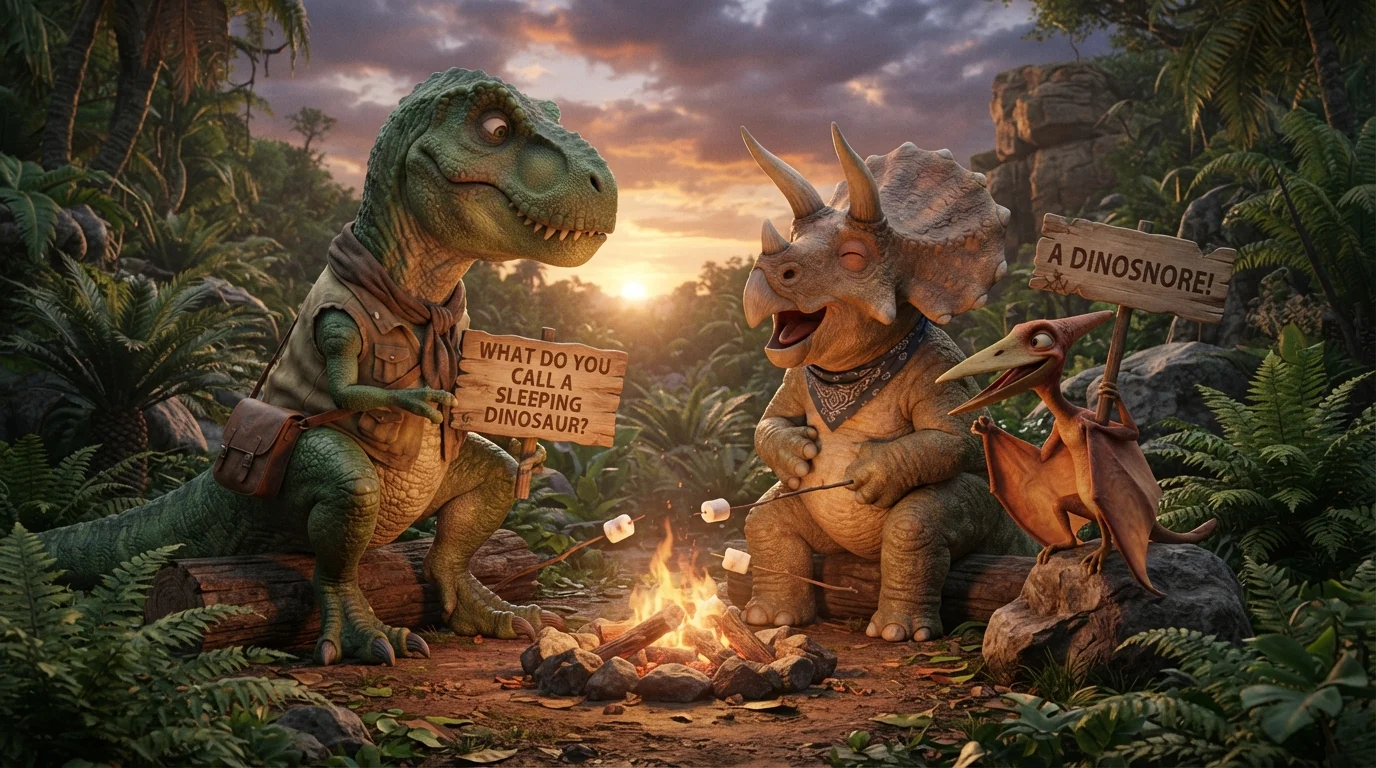
- What do you call a dinosaur who loves sleeping? 👉 A dino-snore
- Why did the dinosaur bring a suitcase? 👉 It was going on a prehistoric vacation
- What happens when a dinosaur tells a secret? 👉 It becomes ancient history
- Why did the dinosaur wear sunglasses? 👉 Because its future was too bright
- What do you call a dinosaur who loves cleaning? 👉 A tidy-saurus
- Why did the dinosaur cross the road? 👉 To prove it was not chicken-sized
🦴 Dinosaur Fossil Riddles
Fossils are clues from the distant past. They can include bones, teeth, footprints, and other traces preserved in rock. These riddles introduce young readers to some of the fascinating evidence scientists use to study prehistoric life.
- I am a rock with a prehistoric secret trapped inside me. 👉 Fossil
- I can preserve the shape of an ancient footprint in stone. 👉 Trace fossil
- I am a dinosaur’s hard tooth that survived long after the animal disappeared. 👉 Fossilized tooth
- I may look like an ordinary rock, but I can reveal clues about ancient life. 👉 Fossil
- I help scientists learn what prehistoric animals looked like and how they lived. 👉 Fossil
- I can show where a dinosaur walked even when its bones are nowhere nearby. 👉 Fossil footprint
- I am the hardened remains of something that lived long ago. 👉 Fossil
- I can preserve a mark, track, or other sign left by an ancient animal. 👉 Trace fossil
- I am carefully uncovered from rock by scientists searching for prehistoric clues. 👉 Fossil
- I may be millions of years old and still tell part of an ancient story. 👉 Fossil
- I am a dinosaur bone preserved inside rock rather than lying in a museum from yesterday. 👉 Fossilized bone
- I help paleontologists piece together the story of ancient life. 👉 Fossil evidence
Paleontology Riddles
Paleontologists investigate prehistoric life using fossils and other evidence. These riddles are great for classrooms and curious readers who want to think like fossil detectives.
- I study fossils to learn about life from the distant past. 👉 Paleontologist
- I carefully remove rock from around an ancient bone without using a time machine. 👉 Paleontologist
- I search the ground for clues about creatures that lived millions of years ago. 👉 Paleontologist
- I study dinosaur bones and other prehistoric remains. 👉 Paleontologist
- I use scientific evidence to reconstruct pieces of Earth’s ancient history. 👉 Paleontologist
- I may carry brushes, tools, and patience while searching for fossils. 👉 Paleontologist
- I examine fossilized bones to learn about extinct animals. 👉 Paleontologist
- I can spend days looking at rocks because one tiny discovery might be important. 👉 Paleontologist
- I help museums tell the story of prehistoric creatures using scientific evidence. 👉 Paleontologist
- I investigate ancient life but cannot interview my subjects. 👉 Paleontologist
🌿 Herbivore Dinosaur Riddles
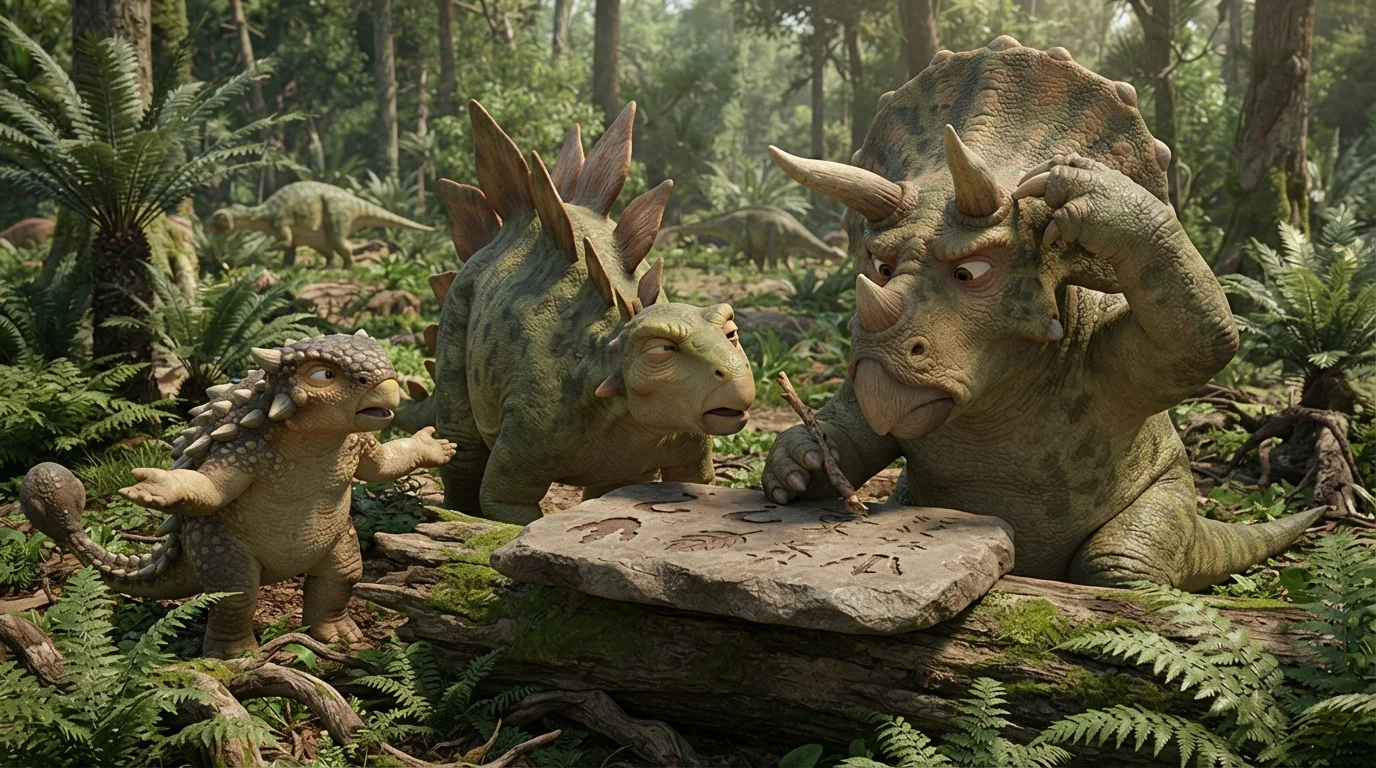
Not every dinosaur was a meat-eater. Many dinosaurs ate plants, and some developed remarkable body shapes that helped them find food or defend themselves.
- I was a giant plant eater with a long neck reaching toward treetops. 👉 Brachiosaurus
- I had three horns and enjoyed a plant-based prehistoric menu. 👉 Triceratops
- I carried tall plates along my back and spikes on my tail. 👉 Stegosaurus
- I was heavily armored and used a powerful tail for defense. 👉 Ankylosaurus
- I had an enormous body, a long neck, and a long balancing tail. 👉 Diplodocus
- I had a wide, flat mouth that helped me gather plants. 👉 Hadrosaur
- I was a long-necked dinosaur built like a giant walking tower. 👉 Sauropod
- I used my beak-like mouth to bite vegetation rather than chase prey. 👉 Triceratops
- I was covered with protective armor and looked like a prehistoric tank. 👉 Ankylosaurus
- I was a plant eater whose tail ended in four sharp spikes. 👉 Stegosaurus
- I browsed on vegetation with a neck that could stretch far above the ground. 👉 Sauropod
- I lived on plants and carried my enormous body on four sturdy legs. 👉 Apatosaurus
🍖 Carnivore Dinosaur Riddles
Sharp teeth, strong jaws, claws, and speed made some prehistoric dinosaurs impressive predators. Can you identify them from their clues?
- I had powerful jaws, huge teeth, and two small arms. 👉 Tyrannosaurus rex
- I had a tall sail on my back and a long crocodile-like snout. 👉 Spinosaurus
- I was a smaller predator known for speed and a curved toe claw. 👉 Velociraptor
- I was a meat-eater with three-toed feet and a large skull. 👉 Allosaurus
- I had a long, narrow head and powerful jaws suited for catching prey. 👉 Spinosaurus
- I was a large predator whose name means “different lizard.” 👉 Allosaurus
- I walked on two legs and used sharp teeth to tear food. 👉 Carnivorous theropod
- I was famous for having one of the strongest bites among known dinosaurs. 👉 Tyrannosaurus rex
- I was a feathered predator with sharp claws and a relatively small body. 👉 Velociraptor
- I had long arms with three-fingered hands and lived alongside other large dinosaurs. 👉 Allosaurus
- I was a giant predator associated with rivers and aquatic hunting. 👉 Spinosaurus
- I was a theropod, meaning I belonged to a group that included many two-legged dinosaurs. 👉 Tyrannosaurus rex
🛡️ Horns, Spikes, Plates, and Armor Riddles
Dinosaurs evolved some amazing body features. Horns, spikes, plates, and armor could help with defense, display, recognition, or other survival needs.
- I had three horns and a large bony frill around my head. 👉 Triceratops
- I carried tall plates along my back like prehistoric solar panels. 👉 Stegosaurus
- I had a heavily armored body and a tail ending in a bony club. 👉 Ankylosaurus
- I carried four long spikes at the end of my tail. 👉 Stegosaurus
- I wore thick armor across my body like a living shield. 👉 Ankylosaurus
- I used a large frill to make my head look even more impressive. 👉 Triceratops
- I had horns above my eyes and another one over my nose. 👉 Triceratops
- I had rows of bony plates running from my neck toward my tail. 👉 Stegosaurus
- I had a tail club that could deliver a powerful defensive swing. 👉 Ankylosaurus
- I looked like a dinosaur built from shields, spikes, and sturdy armor. 👉 Ankylosaurus
🪽 Flying Reptile and Prehistoric Creature Riddles
Here is a tricky twist: not every prehistoric creature people call a “dinosaur” actually was one. Pterosaurs were flying reptiles, while marine reptiles belonged to different groups. These riddles can help sharpen that distinction.
- I flew through prehistoric skies but was not technically a dinosaur. 👉 Pterosaur
- I had wings made from skin stretched over elongated finger bones. 👉 Pterosaur
- I was a famous flying reptile with a long head crest in some species. 👉 Pteranodon
- I lived in the oceans during the age of dinosaurs but was not a dinosaur myself. 👉 Marine reptile
- I had flippers and a streamlined body for life in ancient seas. 👉 Plesiosaur
- I was a large marine reptile with powerful jaws and a long body. 👉 Mosasaur
- I ruled prehistoric skies with wings instead of walking on dinosaur feet. 👉 Pterosaur
- I soared above ancient landscapes while dinosaurs walked below. 👉 Pterosaur
- I lived in water and had a long neck with four flippers. 👉 Plesiosaur
- I was a powerful marine predator from the age of reptiles. 👉 Mosasaur
🌍 Prehistoric World Riddles
Dinosaurs lived in a world very different from ours. Continents shifted, climates changed, and ecosystems looked nothing like today’s neighborhoods and cities.
- I am the ancient supercontinent that once brought many modern landmasses together. 👉 Pangaea
- I am the study of Earth’s ancient life and environments through fossils and other evidence. 👉 Paleontology
- I was a time when dinosaurs dominated many land ecosystems. 👉 Mesozoic Era
- I came before the Mesozoic and ended with one of Earth’s great extinction events. 👉 Paleozoic Era
- I came after the Mesozoic and include the world of mammals we know today. 👉 Cenozoic Era
- I am a layer of rock that can preserve evidence from ancient environments. 👉 Sedimentary rock
- I can preserve footprints, burrows, and other signs left by ancient animals. 👉 Trace fossil
- I describe the study of ancient environments and ecosystems. 👉 Paleoecology
- I am the process that can turn buried remains into fossils over very long periods. 👉 Fossilization
- I am a natural record that helps scientists reconstruct Earth’s distant past. 👉 Fossil record
🧩 Hard Dinosaur Riddles for Dino Experts
Think you know your dinosaurs? These clues are a little trickier. They are ideal for older kids, teens, adults, science classes, and serious prehistoric enthusiasts.
- My name means “three-horned face,” and my large frill framed my head. 👉 Triceratops
- My name means “tyrant lizard king,” and I had enormous jaws. 👉 Tyrannosaurus rex
- My name means “roof lizard,” although my back plates were not a roof. 👉 Stegosaurus
- My name means “armored lizard,” and my body lived up to the description. 👉 Ankylosaurus
- My name means “spine lizard,” a fitting clue for my tall back sail. 👉 Spinosaurus
- I am famous for a long neck, but my name is connected with an arm-like posture. 👉 Brachiosaurus
- My name means “swift thief,” although popular culture often exaggerates my size. 👉 Velociraptor
- My fossils have been found in Mongolia, where my name has become famous among dinosaur fans. 👉 Velociraptor
- I belonged to a group of long-necked dinosaurs known as sauropods. 👉 Diplodocus
- I was a massive theropod whose name means “different lizard.” 👉 Allosaurus
- I had a long skull and conical teeth suited to a predator that may have hunted around water. 👉 Spinosaurus
- I was a horned ceratopsian famous for my enormous head and frill. 👉 Triceratops
🎒 Dinosaur Riddles for School and Classroom Activities
Teachers can use dinosaur riddles as warm-up questions, science activities, vocabulary games, reading exercises, or quick team challenges. They can also encourage students to explain which clue helped them solve each puzzle.
- I am a scientist who studies prehistoric life through fossils. 👉 Paleontologist
- I am the preserved remains or trace of an ancient living thing. 👉 Fossil
- I was a plant-eating dinosaur famous for three facial horns. 👉 Triceratops
- I was a meat-eating dinosaur famous for my massive jaws. 👉 Tyrannosaurus rex
- I was a plant eater with plates along my back. 👉 Stegosaurus
- I was a heavily armored dinosaur with a tail club. 👉 Ankylosaurus
- I was a long-necked dinosaur that belonged to the sauropod group. 👉 Diplodocus
- I am the time period that came after the Triassic and before the Cretaceous. 👉 Jurassic Period
- I am the period when Tyrannosaurus rex and Triceratops lived. 👉 Cretaceous Period
- I am the earliest period of the Mesozoic Era. 👉 Triassic Period
- I am the name for a scientist who studies rocks, Earth materials, and geological history. 👉 Geologist
- I am evidence in rocks that helps scientists understand ancient life. 👉 Fossil record
🎉 Dinosaur Riddles for Parties and Family Games
Planning a dinosaur party? These quick clues work well for group games. Read each one aloud and give everyone a few seconds to shout out their answers. For a bigger challenge, hide the answers and keep score.
- I have a roar, tiny arms, and a famous three-letter nickname: T. 👉 Tyrannosaurus rex
- I wear three horns but never need a cowboy hat. 👉 Triceratops
- I have plates on my back but cannot serve dinner on them. 👉 Stegosaurus
- I have a tail club but play no sports. 👉 Ankylosaurus
- I have a long neck but never wear a scarf. 👉 Brachiosaurus
- I have a huge sail but cannot catch a breeze like a boat. 👉 Spinosaurus
- I am famous for speed and a curved claw on my foot. 👉 Velociraptor
- I have a long tail and a long neck, making my body look like a prehistoric bridge. 👉 Diplodocus
- I am a giant meat-eater whose name sounds like an enormous lizard. 👉 Tyrannosaurus rex
- I am a dinosaur with a duck-like bill but no feathers for flying. 👉 Hadrosaur
- I look like a prehistoric tank with armor from head to tail. 👉 Ankylosaurus
- I have horns and a frill, but I never need a helmet. 👉 Triceratops