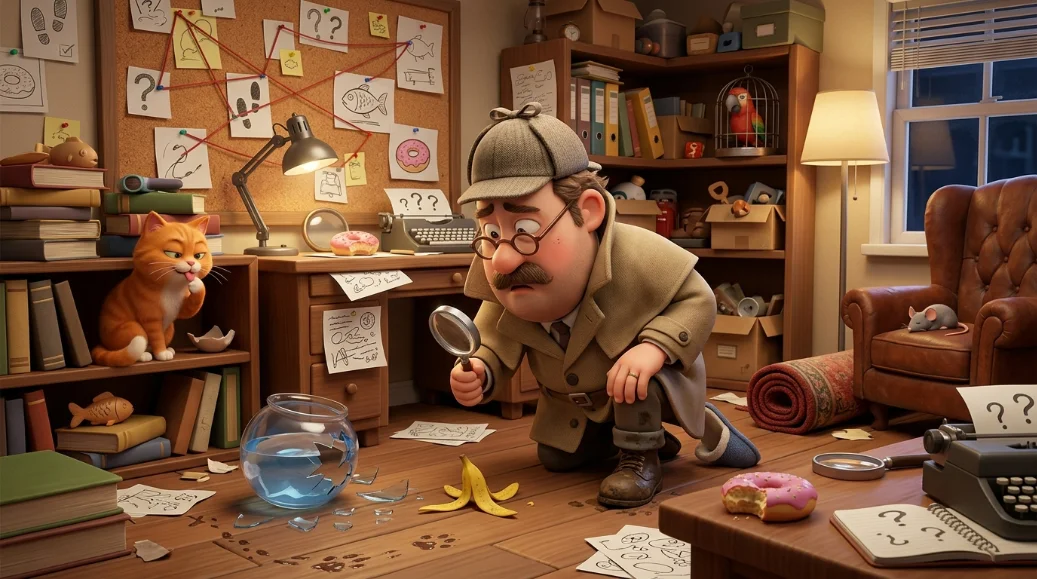
🔎 Classic Detective Riddles
These classic detective riddles are a great place to begin. Look closely at each clue before making your guess.
- I help a detective see tiny details. What am I? 👉 A magnifying glass
- I record clues, names, and observations. What am I? 👉 A detective notebook
- I am left behind when a shoe touches soft ground. What am I? 👉 A footprint
- I can reveal who touched a smooth surface. What am I? 👉 A fingerprint
- I shine light into dark places. What am I? 👉 A flashlight
- I ask questions and search for answers. Who am I? 👉 A detective
- I contain information about a mystery. What am I? 👉 A case file
- I am a small detail that helps solve a mystery. What am I? 👉 A clue
- I am collected to help prove what happened. What am I? 👉 Evidence
- I am the answer that explains a mystery. What am I? 👉 The solution
👣 Footprint Detective Riddles
Footprints can tell an interesting story. These detective riddles ask you to follow the trail.
- I can appear in mud without being written. What am I? 👉 A footprint
- I can show which direction someone walked. What am I? 👉 A footprint
- I disappear when rain washes me away. What am I? 👉 A footprint
- I can be found in sand, snow, or mud. What am I? 👉 A footprint
- I show the shape of a shoe without showing the person. What am I? 👉 A footprint
- I am a trail that a detective may follow. What am I? 👉 Footprints
- I am tiny compared with a person but can tell where they went. What am I? 👉 A footprint
- I appear when a shoe presses against soft ground. What am I? 👉 A footprint
- I can point toward a door or away from it. What am I? 👉 A footprint
- I may be the first clue at a mystery scene. What am I? 👉 A footprint
🖐️ Fingerprint Mystery Riddles
Fingerprints are another favorite mystery clue. See if you can solve these detective riddles.
- I have tiny lines on your fingertip. What am I? 👉 A fingerprint
- I can be left on glass without being noticed. What am I? 👉 A fingerprint
- I am different from the fingerprint of another person. What am I? 👉 Your fingerprint
- I can be found on a smooth cup. What am I? 👉 A fingerprint
- I belong to your finger but help a detective identify you. What am I? 👉 A fingerprint
- I am a pattern that stays on your fingertip. What am I? 👉 A fingerprint
- I cannot talk, but I may tell a detective who touched something. What am I? 👉 A fingerprint
- I can hide on a shiny surface until someone looks closely. What am I? 👉 A fingerprint
- I am made of tiny ridges and lines. What am I? 👉 A fingerprint
- I am a silent clue left by a person’s hand. What am I? 👉 A fingerprint
🧠 Clever Detective Brain Teasers
These detective riddles require more than simply spotting an object. Read every word carefully.
- A man walks in the rain without an umbrella, but his hair stays dry. Why? 👉 He is bald
- A detective sees a wet floor but no rain. What should they ask? 👉 Where did the water come from?
- A room has a broken window, but all the glass is outside. What might that suggest? 👉 The window may have been broken from inside
- A suspect says they were outside during heavy rain, but their shoes are dry. What seems unusual? 👉 The dry shoes
- A detective finds two cups of tea, but one is still warm. What could that clue suggest? 👉 Someone recently used it
- A person says they were asleep, but a message was sent from their phone. What should be investigated? 👉 Who sent the message
- A detective finds fresh footprints beside an old clock. Which clue may be more useful for recent activity? 👉 The fresh footprints
- A mystery has many clues, but one contradicts the others. Which should be investigated carefully? 👉 The contradictory clue
- A suspect gives different answers to the same question. What should the detective examine? 👉 The differences
- A detective reaches a conclusion before checking the evidence. What should they do next? 👉 Check the evidence
🔐 Secret Code Detective Riddles
Can you crack the code? These detective riddles are all about hidden messages and secret communication.
- I hide words behind symbols or letters. What am I? 👉 A code
- I turn letters into another set of symbols. What am I? 👉 A cipher
- I can be read only when you know the secret method. What am I? 👉 A coded message
- I hide writing until the right trick reveals it. What am I? 👉 Invisible ink
- I use dots and dashes to send messages. What am I? 👉 Morse code
- I protect an account with a secret word. What am I? 👉 A password
- I turn ordinary letters into a secret pattern. What am I? 👉 A cipher
- I contain words that need to be decoded. What am I? 👉 A secret message
- I solve hidden messages. Who am I? 👉 A codebreaker
- I replace one letter with another. What kind of code is this? 👉 A substitution cipher
🗝️ Missing Object Mystery Riddles
A missing object can become a fascinating case. These detective riddles help you follow the evidence.
- A pencil disappears, and its eraser is under a chair. What should you check first? 👉 The area around the chair
- A toy disappears, but toy-car tracks lead under a sofa. Where should you look? 👉 Under the sofa
- A missing key is found beside a locked door. What should you investigate? 👉 How the key got there
- A missing book is discovered inside a backpack. What should you ask? 👉 How it got inside
- A spoon is found beside an empty bowl after going missing. What might have happened? 👉 Someone used it
- A red ball disappears, but red marks lead outside. What should you follow? 👉 The red trail
- A missing hat is found beside the door. What is the simplest explanation? 👉 Someone left it there
- A missing necklace is discovered near a jewelry box. What should you inspect? 👉 The jewelry box
- A sandwich disappears and leaves crumbs behind. What should the detective follow? 👉 The crumbs
- A toy is missing from the floor but found behind a curtain. What was probably missed? 👉 The hiding place
👀 Observation Detective Riddles
Great detectives notice details that other people overlook. These detective riddles test your observation skills.
- Four people enter a room, but only three coats are hanging up. What should you notice? 👉 One person has no coat
- A blue cup is found where everyone says only red cups were used. What should you investigate? 👉 Where the blue cup came from
- A wet towel lies beside a dry swimming pool. What question should you ask? 👉 Where did the towel get wet?
- A lamp is unplugged in a room where someone claims they were reading. What seems unusual? 👉 The unplugged lamp
- A cake has six candles but five children. What does that prove? 👉 Only that there are six candles
- A muddy shoe sits beside a clean carpet. What should you watch for? 👉 Mud on the carpet
- A window is open and papers are scattered nearby. What simple explanation might work? 👉 Wind moved the papers
- A red coat is described by one person, but everyone else saw blue. What should be checked? 👉 The coat color
- A second cup is still warm in an empty room. What could that tell you? 👉 Someone may have recently been there
- A note matches someone’s handwriting. What could a detective compare? 👉 Other examples of their handwriting
🚪 Locked Room Detective Riddles
Locked rooms make great mysteries. Try these detective riddles before looking at the answers.
- A locked room has an open window. What should the detective inspect? 👉 The window
- A key is found inside a locked room. What question should be asked? 👉 How was the door locked?
- A locked room has a spare key nearby. What should be investigated? 👉 Where the spare key came from
- A locked door has no damage, but someone entered. What simple explanation is possible? 👉 They had a key
- An open window has muddy footprints beneath it. What clue matters? 👉 The footprints
- A room has a pet flap and a locked door. What other entrance should be considered? 👉 The pet flap
- A locked cabinet has its key sitting on top. What should be investigated? 👉 Who placed the key there
- A hidden door is found behind a curtain. What solved the mystery? 👉 Noticing the second door
- A ladder is beneath an open window. What might it explain? 👉 How someone reached the window
- A locked room seems impossible until another entrance is discovered. What solved the case? 👉 Observation
🧪 Evidence Detective Riddles
Evidence helps turn guesses into stronger explanations. These detective riddles focus on clues that tell part of a story.
- I am a small detail that helps solve a case. What am I? 👉 A clue
- I can be a photograph that captures an important detail. What am I? 👉 Evidence
- I can be a torn piece of fabric. What am I? 👉 Evidence
- I can show when something happened. What am I? 👉 A timestamp
- I can connect an object to a person. What am I? 👉 Evidence
- I may show that something was moved. What am I? 👉 A clue
- I can be a note found at a mystery scene. What am I? 👉 Evidence
- I can be a footprint left behind. What am I? 👉 Evidence
- I can be a fingerprint on a glass. What am I? 👉 Evidence
- I help a detective understand what happened. What am I? 👉 Evidence
🕰️ Time Mystery Riddles
Time can be an important clue. These detective riddles ask you to think about clocks, schedules, and timing.
- A clock says 3:00 while the sun is setting. What should you check? 👉 Whether the clock is correct
- Someone arrives at 11:30 for a meeting at noon. Are they early or late? 👉 Early
- A candle burns for an hour and becomes shorter. What happened? 👉 Time passed
- A clock stops at midnight. What can you know? 👉 The clock stopped at midnight
- Someone says they arrived at 8:00, but the clock says 7:30. What should be checked? 👉 Which clock is accurate
- A mystery begins at sunrise and ends at sunset. When did it happen? 👉 During the day
- A note says “Meet me tomorrow.” When is the meeting intended? 👉 The next day
- A clock gains ten minutes every hour. Can it eventually show the right time? 👉 Yes
- A cup of fresh tea sits beside a stopped clock. What should be investigated? 👉 When the tea was made
- A suspect says they arrived before noon, and the clock says 11:45. Is the statement possible? 👉 Yes
🧍 Suspect Detective Riddles
Suspects may provide useful information, but their stories can also contain clues. See what you notice in these detective riddles.
- A suspect says they were at the beach, but their shoes are covered in snow. What seems strange? 👉 The snow-covered shoes
- Someone says they never entered the kitchen, but flour is on their sleeves. What should be questioned? 👉 How the flour got there
- A suspect says they were asleep, but their phone sent a message. What should be checked? 👉 Who used the phone
- Someone says they were outside during rain, but their clothes are dry. What seems unusual? 👉 The dry clothes
- A suspect says they never touched the cake, but frosting is on their finger. What clue stands out? 👉 The frosting
- Someone claims to have lost a shoe yesterday, but fresh footprints match it today. What should be investigated? 👉 When the shoe was used
- A person says they cannot write, but a note matches their handwriting. What should be compared? 👉 Their handwriting
- A suspect says they arrived by bicycle, but the bicycle has not moved. What should be checked? 👉 Their story
- A person says they wore red, but everyone saw blue. What detail conflicts? 👉 The clothing color
- A suspect answers a question before hearing all of it. What might that make the detective wonder? 👉 How they knew the question
🧩 Logic Detective Riddles
These detective riddles are designed for readers who enjoy putting clues together.
- A clue fits two suspects equally well. What should the detective find? 👉 Another clue
- A suspect gives three statements, but only one is true. What should the detective do? 👉 Test each statement
- Two suspects tell exactly the same story. What should the detective consider? 👉 Whether they planned the story together
- A clue makes sense only with another clue. What should the detective do? 👉 Connect the clues
- A detective has three keys and one lock with no penalty for trying. What is simplest? 👉 Try the keys
- One clue contradicts everything else. What should happen next? 👉 Investigate the contradiction
- A detective has two possible explanations. What should they compare? 👉 The evidence supporting each one
- A suspect’s story changes each time it is told. What should be examined? 👉 The differences
- A detective makes a guess without checking evidence. What should happen next? 👉 The evidence should be checked
- Several clues point to the same answer. What does that provide? 👉 Stronger support for the answer
🏫 School Detective Riddles
School can be full of tiny mysteries. These detective riddles turn everyday classroom situations into fun cases.
- A classroom pencil disappears, and pencil shavings are found near the art table. Where should you look? 👉 Near the art table
- A wet footprint appears near the science room. What should you follow? 👉 The footprint
- A missing book is found inside the classroom library. What should you investigate? 👉 Where it was last seen
- A lunchbox disappears, but its name label is found on a table. What could it reveal? 👉 Who owns the lunchbox
- A marker is missing, and its cap is under a desk. Where should you look? 👉 Near the desk
- A classroom window is open and papers are scattered. What could have moved them? 👉 The wind
- A mystery note is found in familiar handwriting. What could you compare? 👉 Handwriting
- A school bell rings early while the clocks show the same time. What should be checked? 👉 The bell schedule
- A backpack is found in the wrong classroom. What clue could identify the owner? 👉 The name tag
- Blue chalk marks lead toward the playground. What should the detective do? 👉 Follow the marks
😂 Funny Detective Riddles
A little humor makes every mystery more fun. These detective riddles add jokes to your investigation.
- Why did the detective bring a pencil? 👉 He wanted to draw conclusions
- Why did the detective carry a notebook? 👉 He wanted to keep the case notes
- Why did the detective look under the bed? 👉 He was looking for clues
- Why did the detective bring a ladder? 👉 The clues were getting high
- Why did the detective carry a camera? 👉 He wanted to capture the evidence
- Why did the detective wear sunglasses indoors? 👉 He wanted to look extra mysterious
- Why did the detective talk to the calendar? 👉 He was looking for dates
- Why did the detective follow the pencil? 👉 It was leaving a trail
- Why did the detective inspect the refrigerator? 👉 Something seemed fishy
- Why did the detective take notes at dinner? 👉 He was investigating the meal
🧒 Easy Detective Riddles for Kids
These beginner-friendly detective riddles are great for younger mystery lovers.
- Who solves mysteries? 👉 A detective
- What helps you see tiny clues? 👉 A magnifying glass
- What does a shoe leave behind? 👉 A footprint
- What can a finger leave on glass? 👉 A fingerprint
- What do detectives follow? 👉 Clues
- What do detectives write notes in? 👉 A notebook
- What helps you see in darkness? 👉 A flashlight
- What do detectives ask suspects? 👉 Questions
- What do detectives search for? 👉 The truth
- What do you call a mystery after it is solved? 👉 A solved case
🧠 Tricky Detective Riddles
Ready for something harder? These detective riddles contain twists that may make you rethink your first answer.
- A person has wet hair, but it has not rained. What could explain it? 👉 They washed their hair
- A man enters a room empty-handed and leaves with a suitcase. How? 👉 The suitcase was already inside
- A footprint is much smaller than the suspect’s shoe. What could that mean? 👉 It belongs to someone else
- A second cup of tea is warm in an empty room. What should the detective ask? 👉 Who recently used it
- Footprints disappear beside a river. What might have happened? 👉 The person crossed the river or followed the water
- A locked door has a key inside it. What should the detective investigate? 👉 Who locked it
- A shadow looks circular even though the object is not round. How? 👉 The angle of light changed the shadow
- A bag enters a shop empty and leaves full. What is the obvious conclusion? 👉 Something was put inside
- A person says they were alone, but two cups are still warm. What should be investigated? 👉 Who used the second cup
- A detective sees a door open and a window closed. Which is the simplest entrance? 👉 The door
🏆 Mystery Lover’s Detective Riddles
For readers who really enjoy solving cases, these detective riddles focus on the language of mystery solving.
- Who is searching for the truth? 👉 The detective
- Who might know something about a case? 👉 A witness
- Who might be investigated during a mystery? 👉 A suspect
- What helps explain what happened? 👉 Evidence
- What is a small detail that helps solve a case? 👉 A clue
- What is the explanation a detective develops? 👉 A theory
- What contains information about a case? 👉 A case file
- What is the process of searching for answers? 👉 An investigation
- What is the final answer to a mystery? 👉 The solution
- What does a detective hope to discover? 👉 The truth